We’re done having fun with butts. This lesson isn’t as stinky, though it’s close. We’ll study the inner leg muscles – the adductors and sartorius.
They’re in the upper inner part of the leg. The inguinal ligament separates them from the abs, ASIS to pubic symphysis. The long sartorius muscle separates the adductors from the quads diagonally. The border in the back is not as obvious. It fades away into fat and then suddenly it’s the hamstrings. Though in certain poses and mostly on athletic people, you might see where the adductor magnus pops out at the top. It can separate the form of the adductors from the hamstrings.
This little section is called the femoral triangle and has nerves, veins, arteries, lymph nodes, and the adductor area in general is prone to having more fat. All this stuff softens the inner leg muscles. This is actually good news for us because in most cases we don’t need to know the individual adductor muscles, just their overall form and occasionally some tendons toward the top. In premium, we’ll go over the anatomy of each adductor in more details because sometime it can be useful.
So, let’s get familiar with the simple forms. You know I love simple forms…
Simple Forms
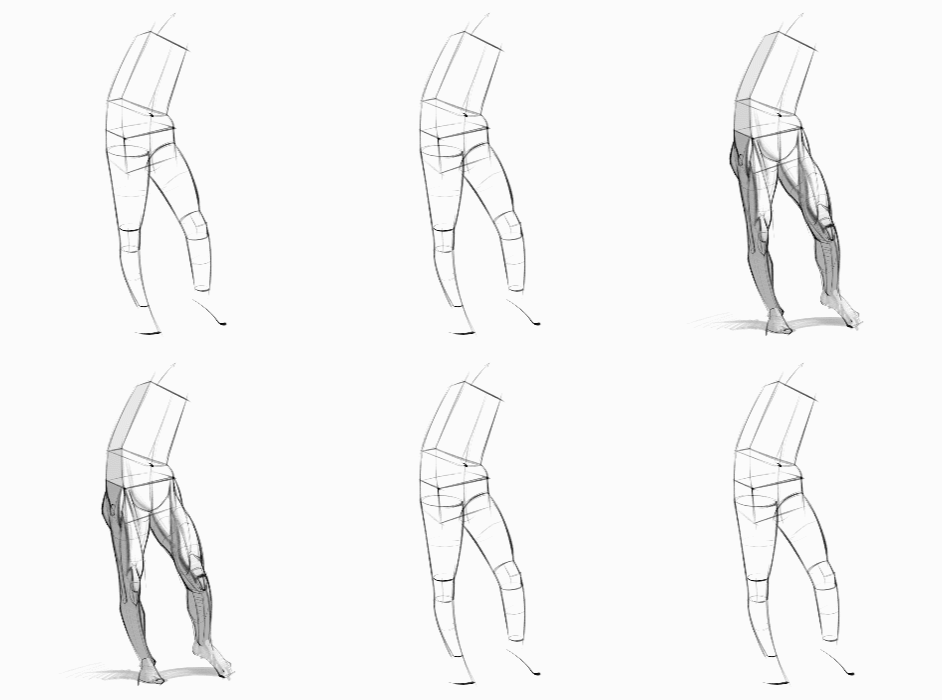
Up to this point in this course and the figure drawing course, we’ve been drawing leg’s as simple cylinders, maybe with a bit of taper, getting thinner toward the knee. And that’s fine for starting our drawings. But now, since we’re learning leg anatomy, we need to be able to take that cylinder and make it into… a leg!
Let’s say we have this seated pose (see below), legs coming at us. Looking at a cross section, we’ll see three main muscle groups. Quadriceps, hamstrings, and adductors. This video is about adductors, so let’s group the quads and hamstrings into one large mass. Now, let’s look at how a leg is different from a cylinder.
In the middle everything is very meaty. You start seeing that indent on the inside where the adductor group attaches to the quads. The front plane is tall and round as the quads project out.
Near the knee, the leg isn’t cylindrical at all. It’s more boxy. The top is meaty, with the quads, and the back is tendinous, with two powerful hamstring tendons on the sides. So, the corners of the box are sharper in the back. It’s like a slice of bread.
The main mass of the quads and hamstrings is boxy and short at the knee and grows much taller and egg-shaped at the hip. The adductors are like a secondary mass that attach on the inside, shaped like a cone or a wedge. You can see how it’s separate from the rest of the leg mass especially in a seated pose like this. The adductor mass hangs down off the leg. The long sartorius muscle actually rounds it out a bit. Without it, the indent between these two forms would be even sharper. Also keep in mind that this area is a major fat storage area. So, that adds to the form and softens the borders.
The sartorius is a great rhythm diagonally across the leg. You’ll see it as as an oblique side plane. So, when we look at it with Bridgman glasses, the quads are a front plane, the sartorius is a side plane, and then the adductors make a triangular front plane, and another side plane is they wrap around to the back. We have 2 “steps” when we think of the front of the leg planarly.
A Few Details
The sartorius and the TFL we learned about last time create a hollow triangle into which the quads dive in to. Sometimes you’ll see this as an indent, but usually just as a flat vertical plane. Remember that the leg cylinder doesn’t start at the ASIS point of the pelvis. We need to drop this vertical for the TFL and sartorius, and then start the leg cylinder a few inches down.
The inside of the leg gets this double curve. Look for that when you’re designing the flow down the leg. Remember how we talked about asymmetry in the limbs. The contours zig zag down the leg. Because female pelvises are wider, the adductor origins are farther apart. So thin females may have a “thigh gap”. Here’s a good example of it.
Like I said, the simple form is the most important thing to learn about the adductors. There’s just a few tendons that you’ll commonly see. Usually when the legs are spread apart, thinning out the fat and pulling the tendons tight. You’ll see the tendons of the adductor longus and adductor magnus.
Assignment
Your assignment is to do quicksketch drawings of the legs from the model photos I’ve provided in the description below. Start with the gesture then focus on drawing the forms of the muscle groups, especially the adductors. We haven’t studied the others yet, so you can keep them as gestural lines, or cylindrical. But don’t just copy the contours. In premium, I’ll show you how to draw all the assignment photos, so you can check your work.
Post your work in the Anatomy for Artists Facebook group.
everything about this… this statue, the choppy waves, the cliffs behind her, the echo, the drumming….. aesthetic
Lyrics in Faroese:
Trøllabundin eri eg eri eg Galdramaður festi meg festi meg Trøllabundin djúpt í míni sál í míni sál Í hjartanum logar brennandi bál brennandi bál
Trøllabundin eri eg eri eg Galdramaður festi meg festi meg Trøllabundin inn í hjartarót í hjartarót Eyga mítt festist har ið galdramaður stóð
English translation:
Spellbound am I, am I The wizard has enchanted me, enchanted me Spellbound deep in my soul, in my soul In my heart burns a smouldering fire, smouldering fire
Spellbound am I, am I The wizard has enchanted me, enchanted me Spellbound in my heart’s root, my heart’s root
Did anyone else just get the shivers? Cuz I’m definitely getting the shivers.
Steve Huston is one of the best artists and teachers of our time. His advice has been helping me figure out how I should approach making art and why I create art in the first place.
In this interview, Steve Huston talks about how to grow as an artist, how to develop a unique style, how to find what calls to you, and much more. It’s a mighty 106 minute conversation filled with golden nuggets. Don’t miss this one.




 Inspiration Haven