a mysterious benefactor who communicates though notes or recordings
the player (who the protagonist is aware of and can talk to)
… our hero harnesses the power of:
friendship
their own mind
grotesque physical transformations
Jungian archetypes
a childhood hobby or pastime
literacy
… and contends with fearsome foes via:
battles of wits
match-three minigames
collectible card duels
turn based JRPG-style combat
ritualised sports matches
talking about their feelings
… to overcome the forces of:
social conformity.
institutional racism.
divine authority.
gender roles.
inevitable fate.
Capitalism.
In the end, it’s revealed that:
God is evil
the narrator and/or the user interface has been lying to you
this has all happened before, and will happen again
the player character is secretly the villain
it was all a dream – but not your dream
we’re all just characters in a video game
… leading to:
revolution.
reconciliation of sworn foes.
the hero’s ascension to godhood.
the hero’s tragic but willing self-sacrifice.
escape from the prison of reality.
universal annihilation.
Reviewers harshly criticise the game’s:
awkward controls
repetitive gameplay
over-wordy dialogue
short and linear narrative
heavy-handed emotional manipulation
low animation budget
… but universally praise its:
outstanding soundtrack.
outstanding soundtrack.
outstanding soundtrack.
outstanding soundtrack.
outstanding soundtrack.
outstanding soundtrack.
The fandom, for their part:
become obsessed with an incidental side character
argue endlessly over the appropriateness of popular ships
produce vast quantities of angsty YouTube AMVs
harass the developers on social media
attempt to start a religious movement
draw lots of anatomically improbable porn
… thus cementing their public reputation as a bunch of weirdos. Meanwhile, the much-anticipated sequel fails to eventuate owing to the fact that:
the creative lead has left the gaming industry to become a lumberjack.
the Kickstarter spent all its money on novelty t-shirts.
the source code has been lost in a mysterious accident.
the developers all burned out on console port QA.
the writer and the artist had a falling-out and hate each other now.
the cliffhanger ending was just trolling you.
Given that I’ve received several asks regarding which game this or that line is referring to, I feel I should clarify that no, each numbered entry is not vagueing about a specific title.
Each numbered entry is vagueing about multiple specific titles.
This is an ultimate masterlist of many resources that could be helpful for writers. I apologize in advance for any not working links. Check out the ultimate writing resource masterlist here (x) and my “novel” tag here (x).
The Metropolis storyline and the rise of Cindi Mayweather is such a brilliant expression of storytelling through so many mediums, and her dedication and forethought in telling this story is incredible.
With this post I listed 10 outline techniques to help writes move their story from a basic idea to a complete set of arcs, plots, sequences and/or scenes. Or to simply expand whatever you have in hands right now.
If you have a vague story idea or a detailed one, this post is for you to both discover and organize. A few technique will work perfectly. A few won’t. Your mission is to find the one that works best for you. That said, I advice you to try out as many techniques as possible.
So, are you ready? Open your notebook, or your digital document, and let’s start.
1. Snowflake method: Start with a one-sentence description of the novel. Then, develop this simple phrase into a paragraph. Your next step is to write a one-page summary based on the paragraph, you can write about characters, motivations, goals, plots, options, whatever you feel like. From this point on, you can either start your book or expand the one-page summary into four pages. And, at last, four pages into a brief description of known sequences of scenes. Your goal is to make the story more and more complex as you add information, much like a forming snowflake.
2. Chapter by chapter: List ten to twenty chapters, give each chapter a tittle and a brief description of what should happen. Then, break each chapter into three to five basic sequences of scenes. Give each sequence a title, a brief description and a short list of possibilities (possibilities of dialogues, scenarios, outcomes, moods, feelings… just play around with possibilities). From this point on, you can either create the scenes of sequences with a one-sentence description for each or jump straight to writing. Your goal is to shift from the big picture to a detail-oriented point of view.
3. Script: This might sound crazy, but, with this technique, you will write the screenplay of your story as if it’s a movie. No strings attached to creative writing, just plain actions and dialogues with basic information. Writing a script will take time, maybe months, but it will also enlighten your project like no other technique. Your goal is to create a cinematic view of your story. How to write a script here.
4. Free writing: No rules, no format, no step, just grab a pen or prepare your fingers to write down whatever idea that comes up. Think of possibilities, characters, places, quests, journeys, evolutions, symbolisms, fears, good moments, bad moments, clothing, appearances. Complete five to ten pages. Or even more. The more you write, the more you will unravel. You can even doodle, or paste images. Your mission is to explore freely.
5. Tag: This technique is ideal if you have just a vague idea of the story. Start by listing ten to fifteen tags related to the story. Under each tag, create possible plots. And, under each plot, create possible scenes. Grab a red felt pen and circle plots and scenes that sparkle your interest.
6. Eight-point arc: With this technique you will divide your story into eight stages. They are Stasis, Trigger, Quest, Surprise, Critical Choice, Climax, Reversal and Resolution. The Stasis is the every-day-life of your main character. Trigger is an event that will change the every-day-life of your character (for better or for worse). Quest is a period of your main characters trying to find a new balance, a new every-day-life (because we all love a good routine). Surprise will take your character away from their new found every-day-life. Critical Choice is a point of no return, a dilemma, your character will have to make the hardest decision out of two outcomes, both equally important. Climax is the critical choice put to practice. Reversal is the consequence of the climax, or how the characters evolved. Resolution is the return to a new (or old) every-day-life, a (maybe everlasting) balance.
7. Reverse: Write down a description of how your story ends, what happens to your characters and to those around them. Make it as detailed as possible. Then, move up to the climax, write a short scenario for the highest point of your story. From there, build all the way back to the beginning.
8. Zigzag: Draw a zigzag with as many up and downs as you want. Every up represents your main character moving closer to their goal. Every down represents your main character moving further from their goal. Fill in your zigzag with sequences that will take your character closer and farther from the goal.
9. Listing: The focus of this technique is exploring new ideas when your story feels empty, short or stagnated. You’ll, basically make lists. Make a long list of plot ideas. Make another list of places and settings. Make a list of elements. And a list of possible characters. Maybe a list of book titles. Or a list of interesting scenes. A list of bad things that could happen inside this universe. A list of good things. A list of symbolism. A list of visual inspiration. A list of absurd ideas you’ll probably never use. Then, gather all this material and circle the good items. Try to organize them into a timeline.
10. Character-driven: Create a character. Don’t worry about anything else. Just think of a character, their appearance and style. Give them a name. Give them a basic personality. Give them a backstory. Develop their personality based on the backstory. Now, give this character a story that mirrors their backstory (maybe a way to overcome the past, or to grow, or to revenge, or to restore). Based on your character’s personality, come up with a few scenes to drive their story from beginning to end. Now, do the same thing for the antagonist and secondary characters.
So, when is it time to stop outlining and start writing?
This is your call. Some writers need as many details as they can get, some need just an basic plot to use as a North. Just remember, an outline is not a strict format, you can and you will improvise along the way. The most important is being comfortable with your story, exploring new ideas, expanding old concepts and, maybe, changing your mind many times. There’s no right or wrong, just follow your intuition.
A question I received today prompted me to write this post because it seems like a lot of writers are struggling with this problem. When you have everything else you need to tell a story, but you can’t figure out the plot, what should you do? The good news is that you really don’t have a lot more to figure out. Once you have your characters down and what their motivations are, the story will begin to tell itself.
Your characters are really the driving force behind your story. They will decide what happens next, they will reveal what should be said through dialogue, and they’ll be there every step of the way as you form your story. They’re in charge. As long as you let them take control, you’ll be able to figure out your plot. But how do you do this? How do you let your characters take charge if you’re the one that created them?
Really know your characters’ motivations.
Your character wants something. If they don’t, they should. Your character has obstacles that stand in the way. If they don’t, they should. Your character has to figure out how to reach their goals. The story is all right there. What does your character want? How will they get it? What stand in their way? How will they overcome these obstacles and get what they want? Will they ever get what they want? Every single character in your story should want something, even if it’s something small. Their motivations and goals will lead to a journey of some kind. They will change. They will have to tackle those issues or people that stand in their way. How they do this will reveal the plot.
Don’t overcomplicate your story.
Writers often worry about a story that’s too simple OR they’re too focused on avoiding what’s been done already. A plot can be super simple, but it can still be extremely interesting. Say your story is about a character who is trying to find a loved one. That might seem like it’s been done to death, but stories about love and friendship are stories that people have loved to read forever. It’s just what you do with it. What world will it take place in? How can you switch up the relationships? How can you add something unique to it? The basic plot of your story can be simple and somewhat cliché as long as you add your own personal touches to it. Also, the original characters you bring to it will add life.
Recognize why you wanted to tell this story.
What idea first inspired you to tell this story? Was there a specific world you wanted to build? What’s so important about this world? What’s the main problem with this world? Focusing on a line of questioning like this for yourself will help you brainstorm and come up with the plot. You really need to remember what led you to tell this story in the first place and what you want to focus on. Even if you just wanted to write a cool protagonist, think about what makes them cool. What do they want? What do they represent for you? Share that with your readers.
To all the writers who have ever been told they need to outline their story, and privately thought “Great. But how do you DO that? What exactly does that mean?! Is there a map? WHAT IS THE SPECIFIC DEFINITION OF THE VAGUE WORD ‘OUTLINE’?”
Good news. Stories have structure. Structure that can be learned. And a fantastic place to start learning structure?
Save the Cat: The Last Book on Screenwriting You’ll Ever Need by Blake Snyder. This book gives a simple outline that most stories follow. And as an introduction to story structure, it can’t be beat.
In Save the Cat, 15 plot points are spelled out in something called a beat sheet. During the outlining process, these “beats” or plot points can be used as an armature or skeleton that your story is built upon.
So what are those 15 plot points?
Opening Image: A snapshot of the hero’s problematic ordinary world, right before the story starts and changes everything.
Set-Up: Further establishing that ordinary world and what the hero does every day, impressing upon the audience or reader what’s wrong, and the idea that something needs to change.
Theme Stated: The truth that the hero will learn by experiencing the story, the statement that will be proven to the audience. But upon first encountering this truth, in this story beat right in the beginning, the hero doesn’t understand or outright refuses to believe it. The theme stated is asking a question, a question which the story will answer.
Catalyst: The ordinary world is shattered. Something unexpected happens, and this event triggers all the conflict and change of the whole story. Life will never be the same after this moment. This is the Call to Adventure.
Debate: But for a moment, the hero won’t be quite sure about answering that call. Leaving behind the ordinary world is difficult – even if the catalyst has come along and disrupted everything – because the ordinary means safety, it means not being challenged, it means avoiding conflict and heartache. Yes, that existence they’re stuck in might be stagnant and unpleasant, but it protects them from facing the intimidating task of growth, of becoming something better.
Break Into 2: And this is when the hero decides to answer the call and cross the threshold of act two, determined to pursue their goal.
B Story: This is when the relationship – which usually carries and proves the theme – starts in earnest.
Fun & Games: This is just what it says: the premise promised a certain type of pure entertainment, and this beat is where we get to experience it fully.
Midpoint: This is either a false victory or a false defeat. Something really really good happens. Or something the exact opposite.
Bad Guys Close In: Forces of opposition and conflict begin to converge on the hero and his goal. Everything begins to fall apart for the hero, the defeats piling up one after another, the main character punching back.
All Is Lost: This is the sequence where absolutely everything falls apart for the hero. The plans fail, the goal is lost, the mentor dies, the villain wins. All is, quite literally, lost.
Dark Night of the Soul: The hero’s bleakest moment is right here. In addition to all of the tangible things that have been lost, hope and the gumption to continue with the story have also vanished. There is usually a hint of death here, of some kind. An actual death, or an emotional or spiritual death.
Break into 3: Ah, but there’s a light at the end of the tunnel. Inspiration occurs, hope is rekindled, courage to pursue the story returns. Usually, this is the moment where the main character learns what they NEED, the truth which will heal them, and allow them to fix their own lives. With this, they are able to snatch victory from defeat.
Finale: And in here, the story goal is pursued once more, but this time from the stronger version of the hero – the version that has learned the theme, and committed to act accordingly.
Closing Image: The opposite of the opening image. This is a snapshot of life after the story, the problems of the ordinary world solved or banished, a new world opening up for the hero. If the opening is the equivalent of “once upon a time” this is saying “And every day after … “
So let’s see how that works! And to see it, let’s look at my favorite short film of all time – Paperman (because this gave me an excuse to watch it several times and listen to the music while writing it.)
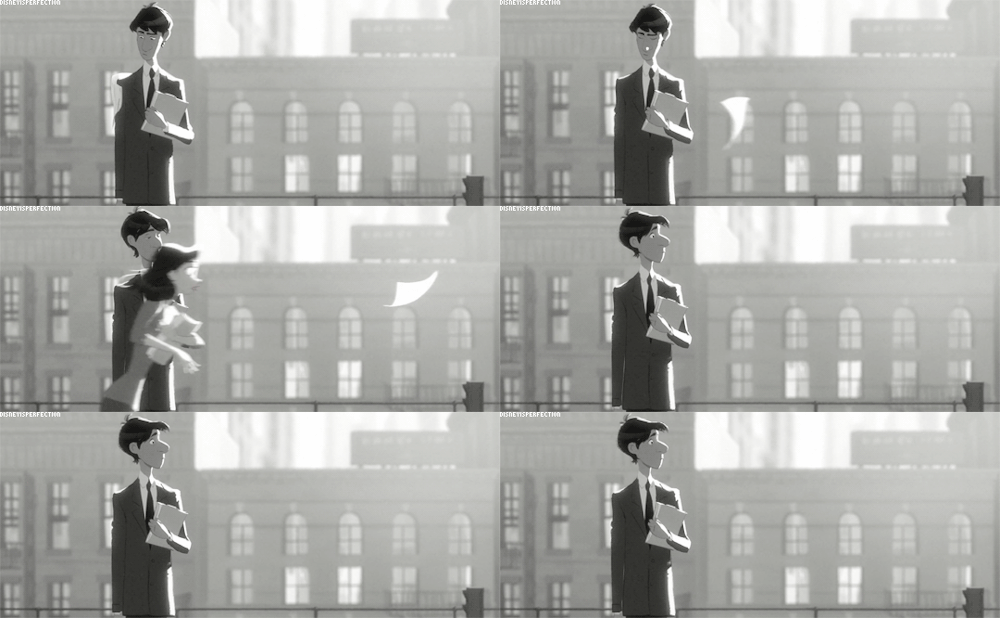
1) Opening Image
We see George, a twenty-something in a sixty-something’s suit and tie, obviously on his way to work, and not looking at all enthused about it. He stares straight ahead, expression bored, lifeless, right on the edge of depressed. Wind from a passing train pushes him slightly, and he lets it, demeanor unchanging.
2) Set-Up
But then a sheet of paper, caught on the wind, hits his shoulder. The paper flies off again, and a young woman appears onscreen, chasing after the paper, as the surprised George watches.
After catching it offscreen, the girl returns, tucking the paper into the stack she carries, smiling slightly. They both face forward, waiting for the train side-by-side, in silence. She’s glancing sideways at him, he’s smiling and fidgeting nervously, but still resolutely facing forward; they’re both aware of each other, seemingly hoping the other will be braver, but neither able to overcome their shyness and the unspoken rules of everyday life.
3) Theme Stated
As a train charges into the station, a paper from George’s stack is snatched by the wind and lands flat on the woman’s face. When he pulls the paper away, she laughs: her lipstick left a perfect kiss mark on the sheet. When George spots it, he laughs too …
but when he opens his eyes, she’s gone. She’s boarded a different train. The kiss-mark paper flaps in the wind as the train begins to move, taking her away. He watches, crestfallen. She glances back. Looks of regret and disappointment are exchanged, both a little wistful. The paper, the symbol of their fleeting memorable meeting, waves goodbye.
Through this little sequence of images, the question of the whole story is asked: Was there a connection between them? Will they find each other again? And on a wider level: What does it take to find love?
Further Set-Up:
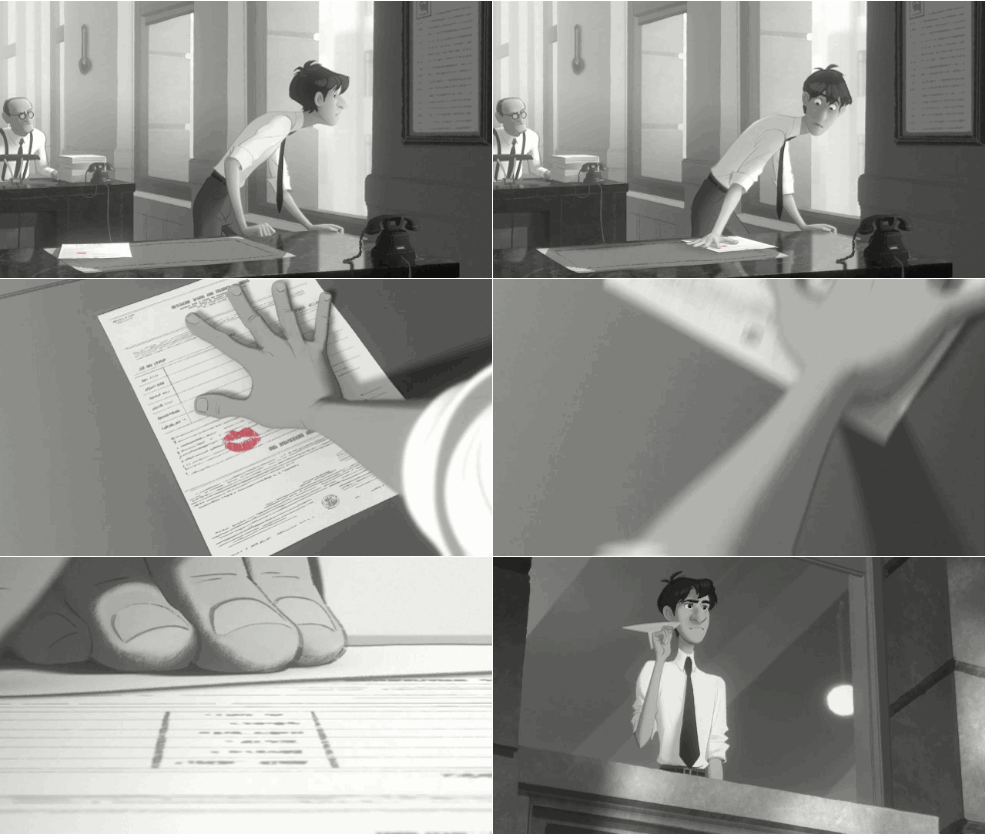
And cut to George behind a desk, in a gray office, dark file cabinets towering behind him, clocks on the wall ticking away his life. Miserable again, he stares at the lipsticked paper. A stack of documents slams onto the desk from on high. The grim-faced boss of the office scowls down at him. George frowns at the stack, then at his boss, who stomps away.
4) Catalyst
Breeze pulls the kissed paper off his desk and out the open window. He catches it just in time, breathing a sigh of relief. And then he sees something. The girl! She’s there! She’s right across the street!
5) Debate
He needs to get her attention! He dithers for a moment, then throws the window wide and enthusiastically waves his arms.
An ominous “ahem” from the boss brings him back inside, and back to his desk. But his attention is still on the girl, and the need to get her attention. He folds a paper airplane, stands before the window, poises the airplane to fly … but he glances at his boss’s office before he throws it. Should he?
6) Break Into Act 2
Yes. Yes, he should. He sends the little airplane messenger to bridge the distance between himself and the girl.
7) B Story
What he should have done while waiting for the train, he’s committed to do now. Talk to her. The relationship of the story has started officially.
8) Fun & Games
In this moment, he becomes the “paper man” of the title. He folds and throws paper airplane after paper airplane. The boss shows up, shoves him back and slams his window. George pauses until he’s gone, then just keeps sending airplanes. They sail over the street, but are intercepted or miss their mark every time.
9) Midpoint
He reaches for more paper … and knocks an empty tray off the desk. He’s run out. Except for one paper, the kissed one, the only one he’s held onto. With a determined look, he folds it precisely into an airplane, stands before the window, breathes to steady himself …
And the wind steals the airplane from his hand, sending it spiraling to the street below, George reaching out pointlessly. On top of this defeat, the girl leaves the office.
10) Bad Guys Close In
Immediately, the boss emerges from his lair. The other office workers hurriedly return to their scribbling, hunched to avoid drawing attention. The girl is leaving the building across the street! George turns from the window … and finds the boss looming above him, glowering, delivering another tall pile of meaningless work.
George sinks into his chair, defeated. But something happens as he watches his boss walk away, as he sees the office workers in neat rows; all of them older versions of George, reflections of what he will become … if he doesn’t do something right now.
He runs, sending paper from the perfect stacks flying in his wake.
11) All Is Lost
But when he escapes the building, and attempts to cross the street, cars nearly kill him. And when he finally makes it to the opposite sidewalk, the girl is nowhere in sight. She’s lost again.
And all he manages to find is the little traitorous paper airplane. The paper he’d believed might mean something, might have signified something important and maybe a little magical. Which it obviously never did.
12) Dark Night of the Soul
Angry, he grabs the plane and throws it with all his strength. He’s lost his job, he’s lost the girl, he’s lost all faith in the magic he’d just started to believe might be real. He stomps towards the train station, returning home.
13) Break Into 3
But fate has other plans. The airplane glides over the city, almost supernaturally graceful and purposeful. It dives between buildings, and lands in the middle of the alley where all the paper planes have collected.
It sits immobile. Then it moves. Moves again. And jumps into flight. The airplane flies over the rest, stirring them into motion, into the air. In a place where not even a breath of wind could reach, there is now a whirlwind of George’s airplanes.
Though the forces of mediocrity tried to keep them apart, something greater has recognized George’s efforts and is going to see things through.
14) Finale
A parade of airplanes follows George down the street.
The leader attaches to his leg. He brushes it off, mad. A flurry of them attach to him, then carry him down the street, unfazed by his fighting.
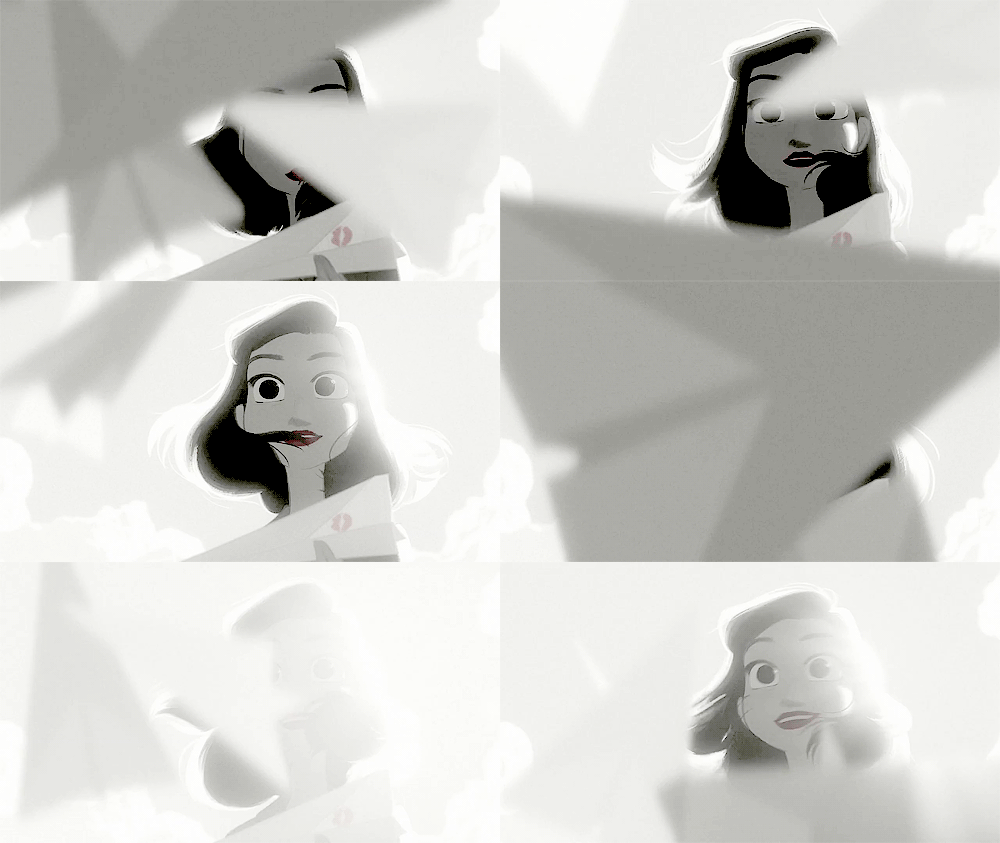
The leader airplane rockets over the city purposefully, finds the girl, then lures her to follow.
She chases after.
Somewhere else in the city, George is being pushed wherever the paper airplanes want him to go. We switch back and forth between George and the girl, as the airplanes push him and beckon her.
Until they’re both on different trains, which stop simultaneously, on opposite sides of the platform. The girl gets out. She fiddles with the airplane, like she’s trying to get it to work again. And just then, a breeze brings hundreds of paper planes skittering all around the platform.
She looks up …
15) Closing Image
And there’s George, covered in paper planes.
He lurches towards Meg, and the airplanes falls away, their work done.
George and Meg face each other, smiling, the barriers of routine and shyness overcome. Exactly what should have happened, exactly what was meant to happen. Putting effort into connection and love prevailed in the end, defeating the allure of life spent in safety and mediocrity. The closing image is the opposite of the opening: he’s not alone, he’s not facing the train leading to his mundane job, he’s not looking miserable and hopeless. He’s facing the girl, his bright and meaningful new future.
***
So! Those are the 15 plot points. This is a fantastic way to begin learning what story structure is, why it works the way it does, and how to precisely pull it off.
For a more in-depth explanation, I highly recommend picking up a copy of Save the Cat. (It holds a special place in my heart; it was the first screenwriting book I ever read, and started obsessive study of storytelling.)












 Inspiration Haven
