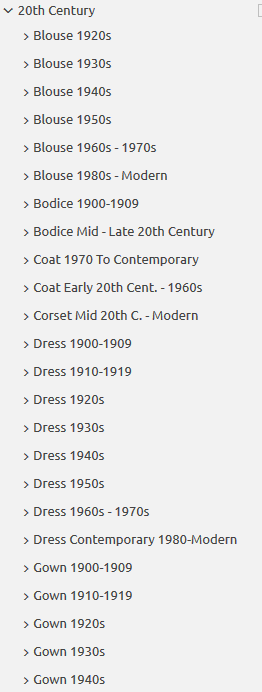
Do you design a lot of characters living in not-modern eras and you’re tired of combing through google for the perfect outfit references? Well I got good news for you kiddo, this website has you covered! Originally @modmad made a post about it, but her link stopped working and I managed to fix it, so here’s a new post. Basically, this is a costume rental website for plays and stage shows and what not, they have outfits for several different decades from medieval to the 1980s. LOOK AT THIS SELECTION:
OPEN ANY CATEGORY AND OH LORDY–
There’s a lot of really specific stuff in here, I design a lot of 1930s characters for my ask blog and with more chapters on the way for the game it belongs to I’m gonna be designing more, and this website is going to be an invaluable reference. I hope this can be useful to my other fellow artists as well! 🙂
Whew, that took forever. There is a TON more info – please check the website here for more details in the footnotes. As you can imagine, any entry on Tibet is going to have more nuance than you could hope to fit in. I tried to portray Pachen and Tibet as complex and flawed as they are/were.
There are more of these comic-esq things. I don’t remember where, but there are some fuckin Badass women out there, my fellas, and these rad illustration/stories of them are really informative and cool
…it’s… it’s at www.rejectedprincesses.com. I mention it like five times in the entry. I watermark the poster image. There’s a link at the end in the notes. This account is the OP. I legitimately don’t know what else I can do to link you back to the other entries.
Stills from non-fiction film ‘Powstanie Warszawskie’ (2014) made entirely from colourized documentary materials of original chronicles filmed in 1944 during the uprising / via Agora Film.
I think we’ve all had enough of the many amrev RPFs that describe guys as smelling like smoke and gunpowder and whatever other boring manly scent. So in an extension of that post about wigs and hair powder, I thought I’d write something brief about pomatum. At the Colonial Williamsburg wigmaker, @azulaludgate, @runawayforthesummer and I sniffed two different types of pomatum: one made from pig’s fat, the other from sheep’s. As has been pointed out, pomatum is heavily scented with things like jasmine, roses, nutmeg, clove oil, lemon, etc.
From what I can recall, the sheep’s fat pomatum contained white wine, apples, and jasmine, among other things, and smelled pretty much like a really nice candle. The pig’s fat one had a warmer, spiced scent to it. I can’t say for certain what the combined smell of unwashed hair, pomatum, and powder would be like, but it’s worth bearing in mind that most people’s hair adjusts pretty quickly if they stop washing it with shampoo.
I know the popular wisdom is that people in the 18th-century reeked and used perfume to cover up their horrible odors, but as was explained in the original wigs post, pomatum served a purpose beyond masking one’s scent, so I wouldn’t go ahead and assume that everyone’s hair smelled terrible. The pomatum is also not an overwhelming scent, it’s relatively subdued. Also! Most of the descriptions of pomatum/pomade that you’ll find online will bring you to posts about women’s hair, but make no mistake: men were using this scented pomatum as well, though I’m not sure if the scents were ever gendered (somehow I doubt it).
tl;dr Writers of amrev RPF, especially writers of romantic stories (*cough*lams*cough*) might want to consider incorporating some of the more pleasant scents of the 18th-century into their writing, and admit to themselves that a lot of these guys just smelled like your grandma’s house.
Everything I’ve read suggested that there were no real gendered fragrances during this time in the 18th century – whether for pomatum or for perfumes in general – and that both women and men used the same floral essences.
Until, you guessed it, the 19th century, when floral became associated with feminine and men started applying their fragrances more subtly and used sharper “rugged” “manly” scents like woodland fragrances.
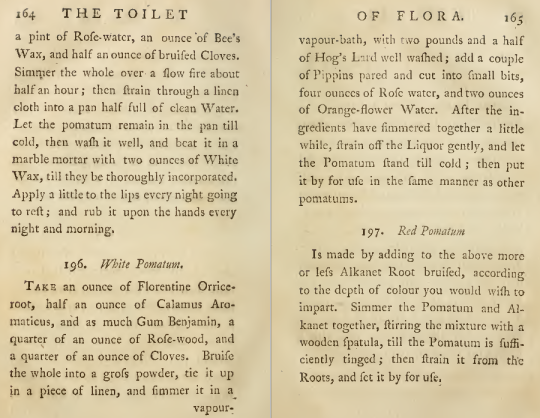
Yes, this is true. Pomatum AND hair powder (which was also very highly scented) were non-gendered– everyone used the same stuff. I don’t know what recipe they use at Williamsburg, but here is a recipe for one that contains apples:
As for smelling bad… Bathing was somewhat a matter of personal preference and affordability. A full bath required a lot of water to be drawn and heated, so enjoying a daily bath in your own home was a rare luxury that only a few, mostly slave owners, would indulge in. Others came up with ingenious ways to take daily baths, such as the guy who figured out how to rig up a shower by pulling a lever, and the guy who could afford to have water piped into a bathtub. Other people with access to a river or lake enjoyed swimming every day. In Europe, public baths WERE a thing. I am not sure how many of these operated in America. Regardless, people kept clean. To quote Orange is the New Black, they washed “tits, pits, and bits” every day, whether they lived in America or Europe.
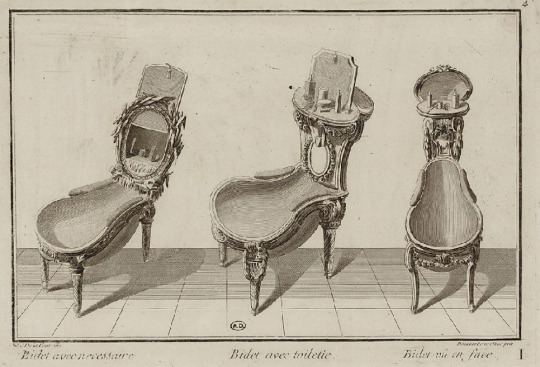
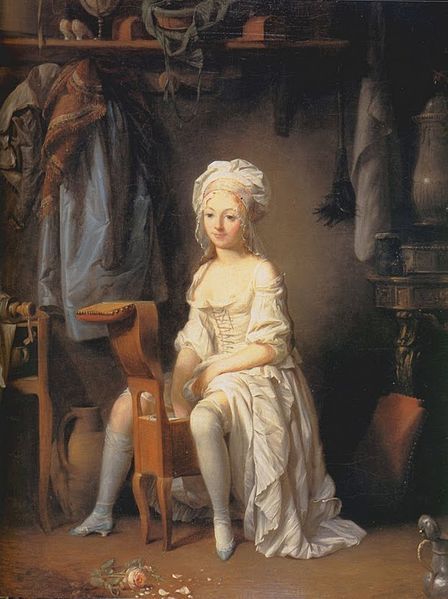
In Europe, people used these early bidets to attend to the most relevant personal hygiene:
Did they have deodorant? No. But in reality, people don’t smell that bad if they wash the relevant parts at the end of the day. Fresh sweat doesn’t smell. It’s bacteria that grows in old sweat that stinks, and as long as you keep your sweatiest parts clean, you won’t smell that bad.
Mind you, contemporary Americans are ridiculous. They think that unless you literally reek of chemicals, if you have the slightest trace of natural human scent, that you stink. That’s our problem. We need to get over it.
Also, part of the hygiene standards of the time involved wearing fresh linen or cottonundergarments, which were changed daily.
In a scientific/historical experiment, a man tried it. He stopped bathing for about a month, but wore clothes comparable to those worn in the eighteenth century and earlier, changing into clean linens (linens being the garments that touched the skin, including both undershirt and underpants) every day. As long as he kept to this routine, he did not smell (this was confirmed by other people he interacted with who were adhering to modern hygiene standards at the time).
Further more, they discovered that when he bathed after adhering to the ‘change your linens’ routine for over a month, bathing caused him to reek. Really stink. It is theorized that this is because it threw off his natural ‘skin/scent rythems’.
People have a lot of misconceptions about hygiene prior to the contemporary era. It’s true that daily immersion bathing was less common from the Middle Ages through the Early Modern era, but that doesn’t mean people were filthy and stinky all the time. People washed, and had other ways of cleaning themselves (such as vigorous rubbing with a linen towel). Sponge baths are just as effective as immersion baths. In the Middle Ages, public bath houses were very popular, and not only for the very rich.
There is no doubt that frequent bathing disrupts the skin’s natural microbiome. Because for so long we’ve assumed that bacteria=bad, frequent cleaning with harsh soap=good, we haven’t learned enough about the natural ecology of human skin. How many dermatological problems are the result of destroying the microbiome? How much body odor is the result of the same? There’s some research on this but nothing definitive. Doesn’t stop people from trying to market products though, and this writer for the New York Times did an experiment with one of them.
In short, we overestimate what it takes to stay clean, reasonably fresh-smelling (i.e. like a clean human, not stinky artificial scents), and to keep the skin healthy. In fact, our obsession with cleanliness and smell might be doing some harm to our skin.
The realities – not the “everybody knows” – of period hygiene is fascinating; it’s useful research for a writer and goes into the same file as “knights in armour couldn’t get up when they fell and got onto horses with cranes”; “medieval European swords were blunt iron clubs and too heavy for modern people to lift” and so on…






 Inspiration Haven