In peacetime, the ruler grows their hair long. In war, they cut it short.
A ruler with long hair is held in great esteem, for defending the peace.
The traditional declaration of war is for the ruler to send their cut-off hair to the enemy ruler. The statement carries greater weight the longer the hair: to receive long hair says that you have angered one who is slow to anger, that you have incurred a wrath not easily woken.
Violent war-mongering leader frantically and aggressively tries to shave just a LITTLE hair off the top of their head into an envelope.
A faraway king receives a heavy wooden crate filled with a coil of the longest hair he has ever seen.
A despised ruler finds hundreds of pounds of cut-off ponytails at her castle entrance, each one belonging to her own people.
A young emperor refuses to cut their hair and insists on trying to make peace with invaders. The enemy leader steps forward, draws their blade, and cuts the emperor’s hair themselves.
Hellen cuts her hair off and throws it in Cathy’s face at her son’s soccer scrimmage.
I’m part of a facebook contest organized by a Switzerland convention called “ Polymanga”.
The contest theme was “Dépêche toi d’aimer:” ( I don’t know how to translate it in english sorry ). But I find it funny to interpret the popular expression “ Run for your life !” by something more romantic ! ^^
If you like it, you can vote HERE by liking my drawing ^^
Thanks in advance everyone !! I have just noticed you’re more than 500 followers ! OO
Okay, for a general overview of (young) medieval women, the culture, and some ideas/misconceptions/cultural parameters about them, I do recommend Medieval Maidens: Young Women and Gender in England, 1270-1540. By its nature/title, it obviously focuses more on England, but France was not so terribly different culture-wise at this point, and this is around the time that most people think of as “medieval.” This book is fairly readable as academic texts go, and absolutely worth going through just for some basics.
In terms of warrior women, I will say that they are very much still the exception rather than the rule. They did exist, but there isn’t some grand conspiracy to cover up legions of Amazons and so forth (though it would be fun if there were). I work on the crusades, and one of the interesting questions is how much women participated as active combatants, if at all. Natasha Hodgson’s Women, Crusading, and the Holy Land in Historical Narrative covers some of this, though she mainly explores the interesting tensions about the presence/existence of women for crusade armies, and their relationships to crusaders – i.e. how much could women participate in a movement that by its nature was designed for arms-bearing knights, i.e. men? Helen Nicholson also has an article, Women on the Third Crusade, that deals with some cases of reported warrior women during said crusade (1187-1192) and what motives chroniclers, especially Muslim ones, might have for reporting or exaggerating their presence. This is a bit earlier, as the crusades are generally accepted to have taken place between 1095-1291, but still medieval.
In terms of French warrior women to look into, I’d say definitely Jeanne de Clisson (that is her wikipedia page, but there are links/references for further reading). She was a fourteenth-century French female pirate called the “Lioness of Brittany,” which if you ask me, is awesome, and everyone knows about Joan of Arc already. In this vein, Grace O’Malley was a 16th-century clan chieftain/pirate captain who met with Queen Elizabeth I; she couldn’t speak English and Elizabeth couldn’t speak Irish, so they communicated in Latin (also, in my opinion, awesome). She also had a badass nickname, “the Sea Queen of Connacht.” Not French, obviously, but yes.
Maud (or Matilda) de Braose was a 12th/13th-century Anglo-French noblewoman known for her military skill (in defending castles for her husband/leading armies in the field). She was supposedly exceptionally tall and also wore armor in fighting, and her death and that of her son (starvation by King John) so outraged the English nobility that there is a clause in the Magna Carta specifically banning such treatment of the king’s subjects. She also made enough of an impression that she is a Welsh folk legend.
Matilda of Tuscany is another woman (late 11th century) remembered for military accomplishments and formidable political prowess, especially in the Investiture Conflict.
Anyway, I think this is most of what I can come up with off the top of my head, but hopefully that is a useful start!
#tbt that time two brothers bought their own planes, learnt to fly them and disguised them as soviet planes so they wouldn’t be questioned and then flew into east germany to rescue their third brother from a park and recorded the entire operation and got away with it
no but legit this is one of my favourite stories from the 20th century it just sums up human ingenuity and how walls just don’t fucking work when people will do anything to cross them
the first brother and a friend paddled over the Elbe on inflatable mattresses in the middle of the night to escape the east. they got picked up by a Wessi police officer, who said something like “bit cold for swimming, ey boys?” and the brother says “not when you’re trying to leave the East.” because all East Germans were automatically citizens of the West too, they were taken into town and established themselves there.
the second brother scoped out a particularly dark stretch of the wall. He escaped over it to the west by getting into a high building and shooting an arrow with a steel cable attached over to another building in the west. He then ziplined over. In response to his escape, the Stasi and the Wall designers built another guard tower in the middle of the stretch so no one else could pull the same stunt.
the two brothers met up and heard that their who was still in East Germany also wanted out. So, they learnt to fly planes and disguised them as soviet planes. This was so, if the border guards saw them, they wouldn’t fire on them – they’d have to ring up the Kremlin and ascertain whether they were actual soviet planes on an organised fly-by. they flew into East Germany at dawn (recording it all on camera because you’ve got to do it for the vine even before vine exists), landed in a park where their brother was hiding in the bushes, loaded him onto one of the planes and flew out of East Germany, laughing all the way.
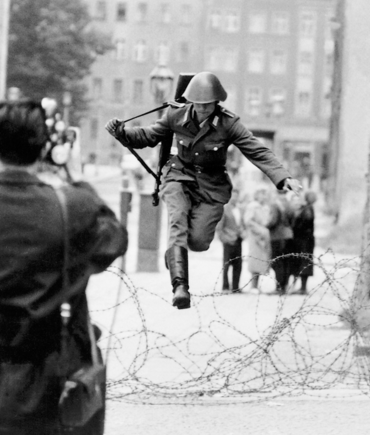
other great moments include – the guy who broke out of the GDR by driving a very low-slung sportscar under a barrier, the family who built two hot air balloons with their bare hands, the guy who managed to windsurf out of East Germany, the man who stole a tank (my hero), the people who removed the petrol tanks from cars so people could squeeze into the gap where the tank should have been, and of course, one of the most famous photos of the 20th century, with Eastern border guard, conrad schumann noping the fuck out of there when he was meant to be on duty guarding the wall when it was under construction in 1961


). But I find it funny to interpret the popular expression “ Run for your life !” by something more romantic ! ^^




 Inspiration Haven